A restaurant website in Ontario needs to do four things: load fast on a phone, show the menu clearly, let guests order direct without paying a commission to a middleman, and tell Google exactly where and what you are. Most restaurant websites manage one of those. The ones doing all four tend to keep more money, more customers, and more control.
Hungry people do not want to do research. They want to eat. If your restaurant's website makes them work, if the menu is a PDF, if the hours are buried, if there is no clear way to order, many of them leave before they ever decide to show up.
Most Ontario restaurants do not have a marketing problem. They have a digital front door problem. Which is a marketing problem, just wearing a different apron.
TL;DR
Ontario restaurant websites fail guests in four predictable ways: slow on mobile, menu hidden or broken, ordering routed through a commission platform, local info Google cannot read. Fix those four and the website starts working the way the restaurant already does. It shows up when people are hungry and makes it easy to say yes.
Where the decision actually happens
Most guests decide where to eat on their phone. Not at a table, not on a laptop, not after extensive deliberation. The moment between "I am hungry" and "I will go somewhere else" is a few seconds and a bad mobile experience.
If the site takes four taps to find the menu, or loads a PDF that requires pinching and squinting, or shows hours from 2022, the decision is already made. Not in your favour.
This is not about having the most sophisticated website on the internet. It is about not losing guests before they arrive. (That is a low bar. A surprising number of restaurant websites clear it with room to spare, and then keep going lower.)
Rule of thumb: if you would not use your own restaurant's website standing on the sidewalk outside while hungry, your guests will not either.
What a restaurant website actually needs to do
Load fast on mobile. Most food searches happen on phones over 4G or LTE. A site that takes six seconds to load loses a meaningful number of visitors before the first image appears. Google also uses page speed as a ranking signal, which means a slow site is invisible twice: once to the guest, once to the algorithm.
Show the menu clearly. Not as a PDF. Not as a link to a third-party page. A real, browsable menu, ideally with photos, that a guest can read without needing to zoom, rotate, or download anything. A PDF menu is the digital equivalent of handing someone a laminated page and saying good luck.
Make it easy to order. A visible order button that goes straight to a cart. Not to a redirect. Not to an app download screen. Not to a DoorDash listing where the guest can also discover five other restaurants while deciding. Straight to ordering from you.
Show the basics accurately. Hours, location, whether you are open right now. These sound obvious. They are routinely done badly. A restaurant that has been closed on Mondays for three years but whose website still says "Mon-Sun 11am-10pm" is not just unhelpful. It is actively sending people to a locked door.
The commission math nobody wants to talk about
Third-party delivery and ordering apps charge restaurants commission rates that typically sit between 15% and 30% per order. That is not a service fee. That is a portion of every single sale, every time, for as long as you use the platform.
On a $25 order at 30% commission, the platform keeps $7.50. The kitchen that cooked the food keeps $17.50. Scale that across a hundred orders a week and congratulations, you have found a business model where someone else gets a meaningful cut of every plate you serve. Without cooking anything.
Own your ordering system and the math changes. The guest pays $25. The kitchen keeps $25. No platform taking a cut, no third-party dashboard to log into, no rules about how you can present your own menu.
This is not an argument against delivery apps entirely. For some restaurants, the reach is worth the cost. The point is: if someone is already on your website, ready to order, they should not have to pay a commission to do it. That is money the kitchen earned.
Local SEO for Ontario restaurants
Local SEO for restaurants is not complicated. It is also not optional if you want new guests to find you.
When someone searches "Caribbean food near me" or "best jerk chicken Guelph," Google decides which restaurants to show based on a few signals:
- Is the business verified and complete on Google Business Profile?
- Are the hours, address, and phone number accurate and consistent across the web?
- Does the website mention the city, neighbourhood, and type of cuisine on real pages?
- Does the website load fast enough that Google considers it worth ranking?
- Are there real reviews, and does the owner respond to them?
Getting these right does not guarantee the top spot in the map pack. Getting them wrong (unclaimed profile, mismatched addresses, no local content, reviews with no responses) makes it very hard to compete with restaurants that did the basics.
A restaurant that has served the same neighbourhood for fifteen years but has an unclaimed Google Business Profile is invisible to anyone who does not already know it exists. That is a missed table, every night.
A real example: Mama Favourite Kitchen, Guelph
Mama Favourite Kitchen has been feeding Guelph since 2000. Nigerian and Caribbean recipes. Family-run. The kind of place where regulars do not need to order and newcomers become regulars after one plate.
The food had always been right. The digital side was a different story. Every online order ran through a delivery app taking a meaningful cut. The website did not carry any of the warmth inside the restaurant, and on a phone it barely held together. Jenny, the owner, had no way to update the menu, hours, or status herself.
When Vortio built the new site, the brief was clear: make it feel like Mama's. Warm, fast, and built for phones, because that is where hungry people are when they decide where to eat.
What we built:
- Mobile-first design. Thumb-friendly, fast, and built for how guests actually browse.
- A direct pickup ordering system: browse the menu, add to cart, pick a time. No app download, no redirect, no commission.
- Local visibility: live hours, Google Maps integration, and an open/closed status so guests always know whether the kitchen is on.
- A backend Jenny runs herself. Menu updates, prices, availability, hours, all without touching code.
The launch campaign we built alongside the site
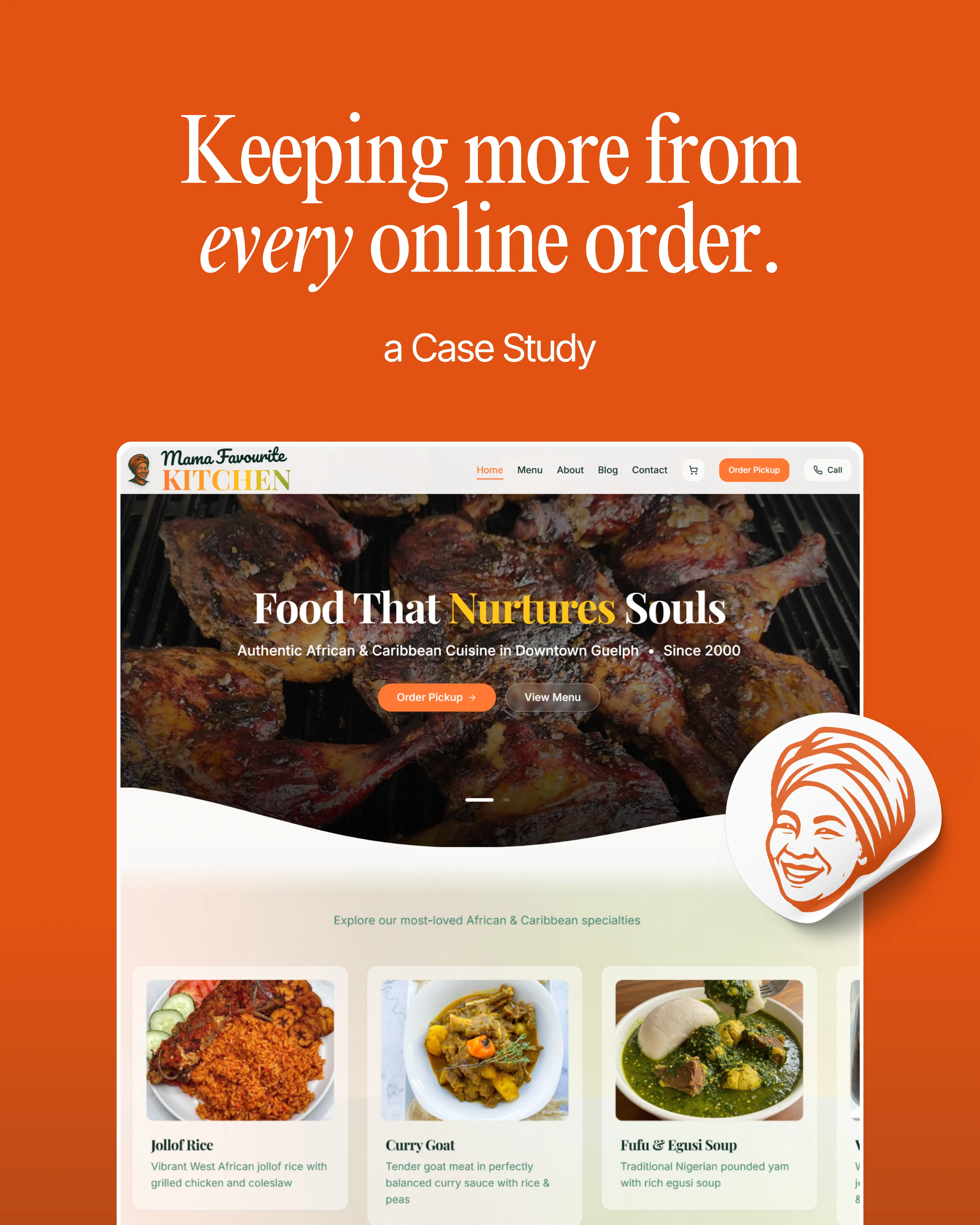
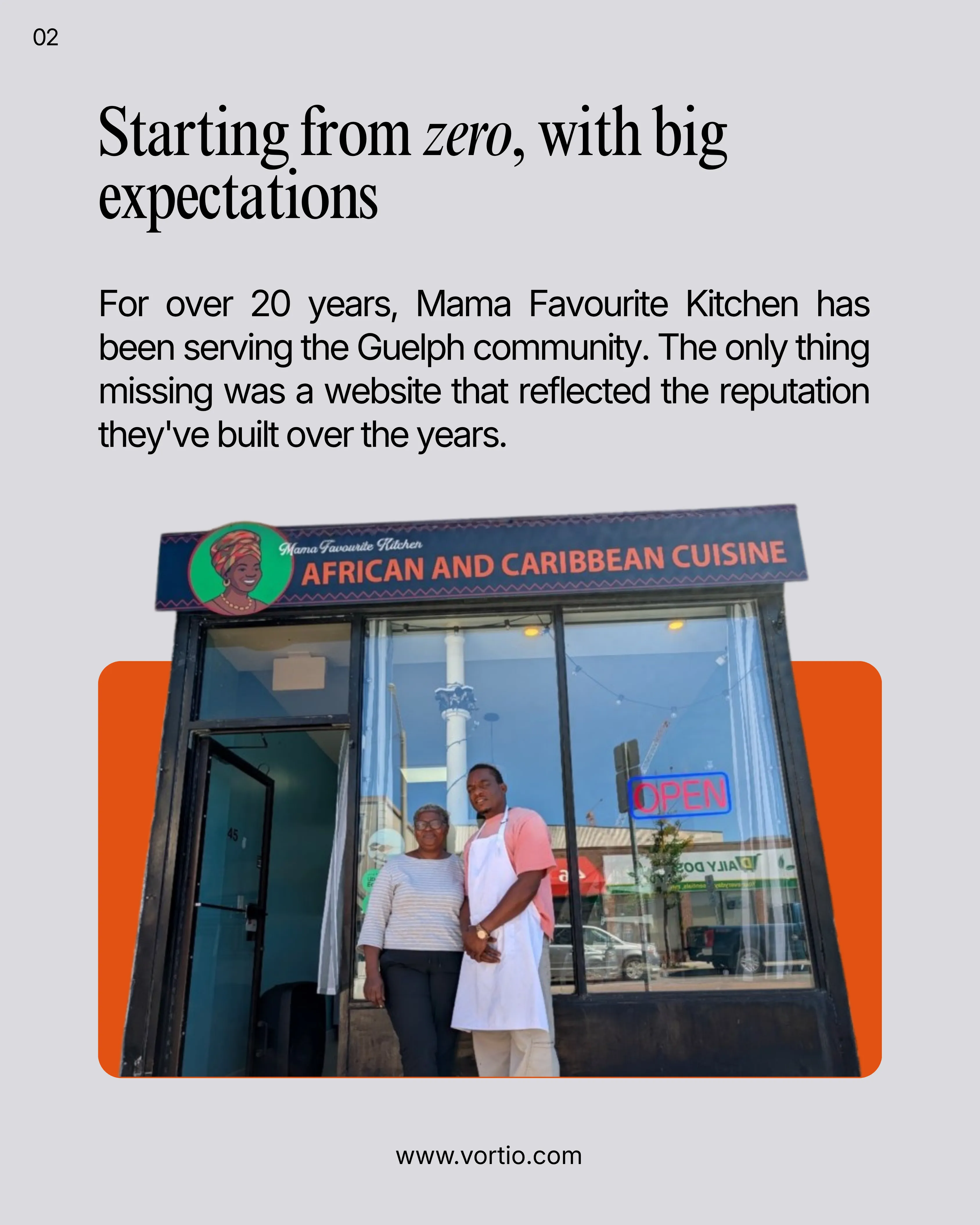
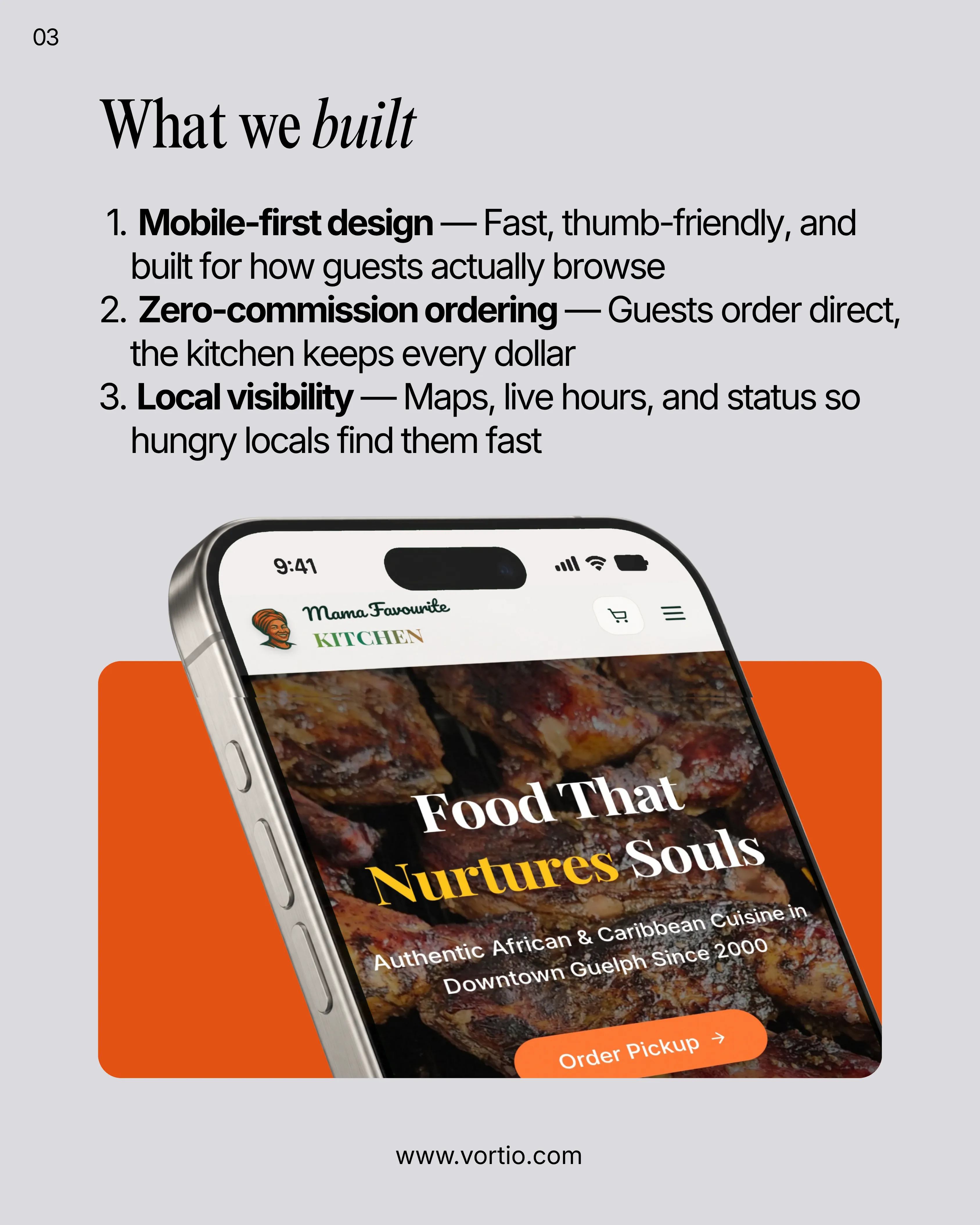
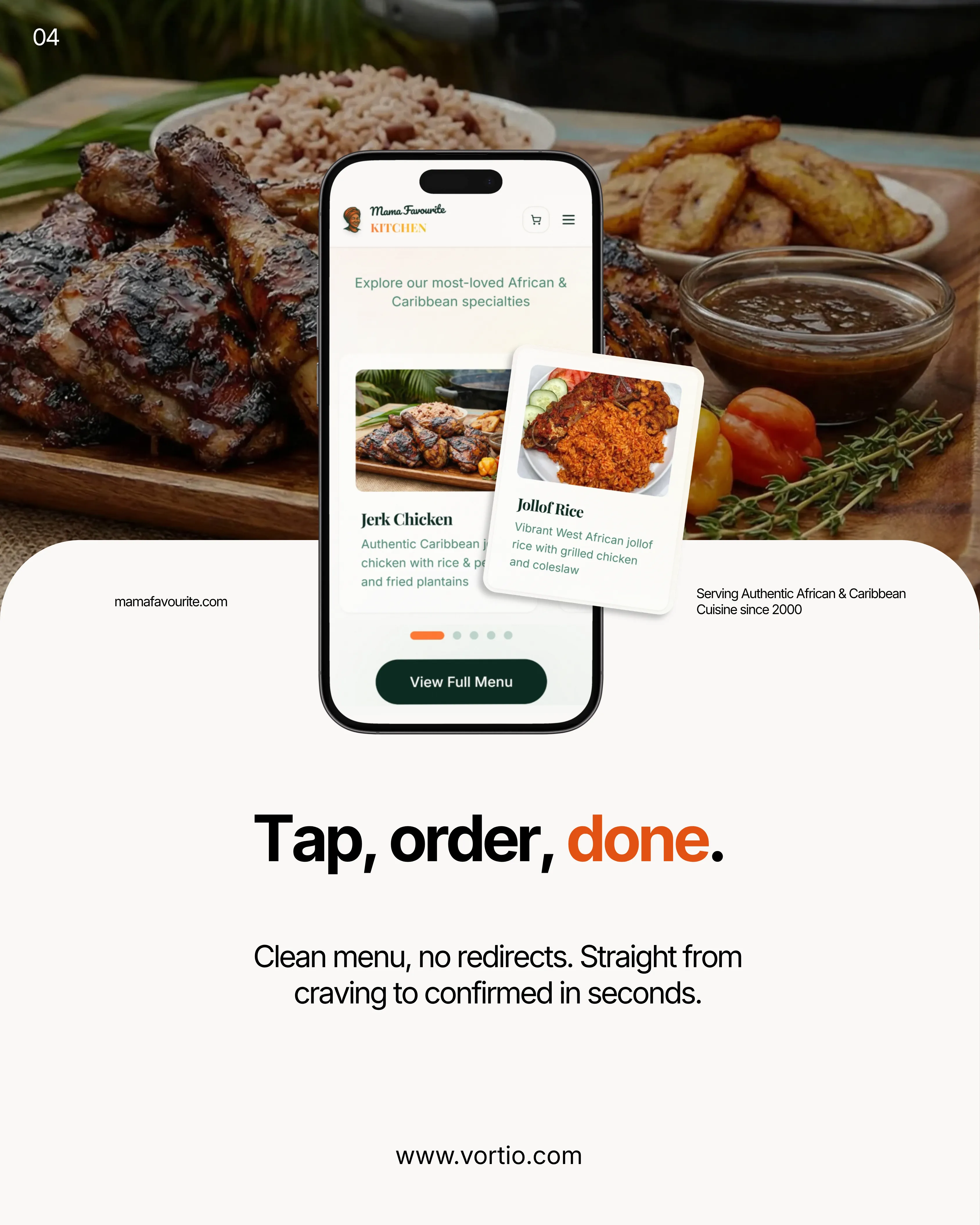
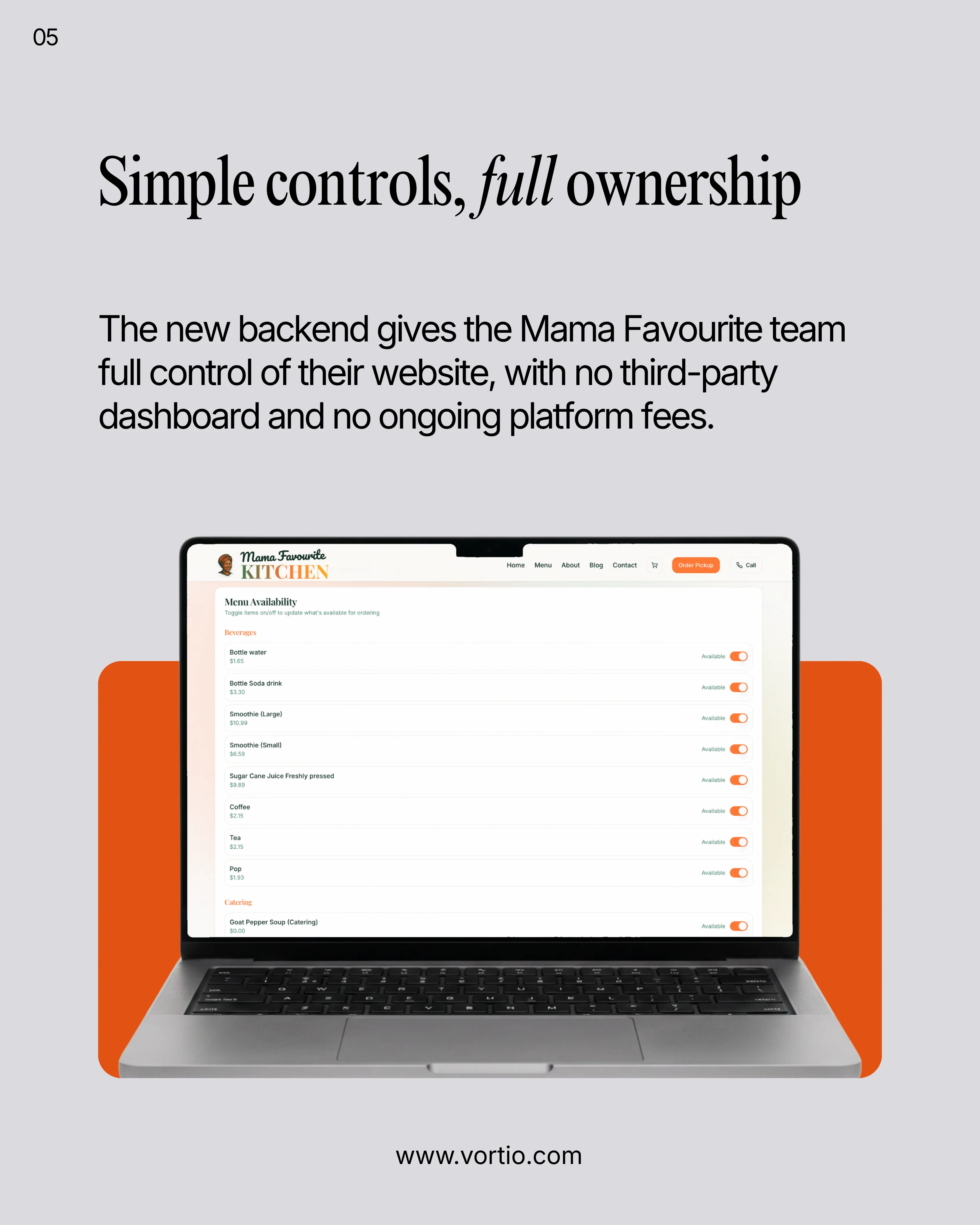
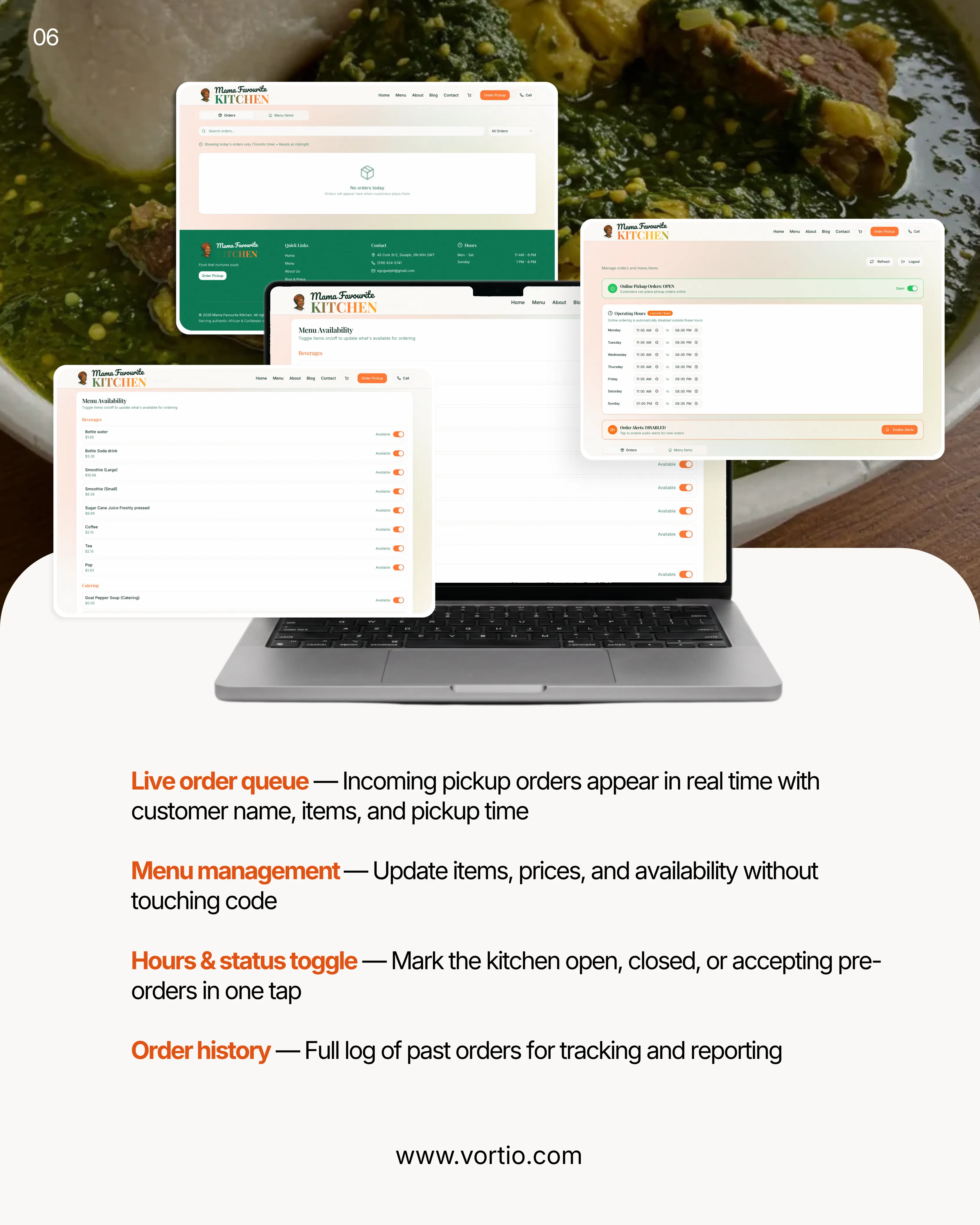
Social campaign designed by Vortio to launch the new site. See the full case study
The result in three numbers: 20%+ saved per direct order. Zero commission layers. 100% of orders owned by the kitchen.
"Vortio built a warm, mobile-first site with our own pickup ordering system, so guests order directly from us and we keep more from each sale. The new design feels like our dining room."Jenny Idahosa, Owner, Mama Favourite Kitchen, Guelph ON
The food did not change. The website finally matched it. Read the full Mama Favourite Kitchen case study to see how it was built.
What the backend should actually do for the kitchen
A restaurant website is not just the part guests see. The part the owner uses matters just as much, and it is the part that most platforms quietly make painful.
Update the menu. Change items, prices, and availability in seconds. If something sells out, mark it unavailable. All without a call to an agency.
Control hours and open status. One toggle to mark the kitchen open, closed, or accepting pre-orders. Not five steps in a third-party dashboard. One toggle.
See orders in real time. Incoming pickup orders should appear immediately with customer name, items, and pickup time. The kitchen should not be hunting across platforms to understand what they just received.
Review order history. A full log of past orders for tracking, reporting, and understanding what is actually popular.
If any of those require a developer call or a login to a platform the restaurant does not own, the system was not built for the kitchen. It was built for someone else's convenience.
When you might not need a full custom build
Honest answer: not every Ontario restaurant needs a custom website from scratch.
If you are a small cafe with a steady local following, no online ordering, and a Google Business Profile that is already in good shape, a clean template site with accurate hours and a menu page might be enough. Add a real phone number, make sure the menu is readable on mobile, and focus on collecting reviews. That is a reasonable starting point.
The moment you want commission-free ordering, a menu your team can actually manage, or a backend that does not require a developer on speed dial, a template starts working against you. Templates are built for the average use case. A kitchen with real order volume, a specific cuisine, and a distinct brand is not the average use case.
Vortio can tell you which one applies to your situation. Sometimes the answer is a sharper template and better local SEO. That is a better answer than building something you do not need.
Straight answers before you pick up the phone
Does a restaurant in Ontario need its own website if it is already on DoorDash and Google?
Yes. Being on DoorDash means a third party owns that customer relationship and takes a commission on every order. Google Business Profile is essential but it is not a website. It is a listing. Your own website is where you control the full experience: menu, ordering, story, hours, and search visibility. Without it, you are building on other people's land, and they can change the rules whenever it suits them.
How do Ontario restaurants rank higher on Google Maps?
Claim and complete your Google Business Profile with accurate hours, address, phone number, and real photos. Make sure the information on your website matches exactly, since even small differences in address formatting can confuse Google. Collect genuine reviews and respond to them. Add local context to your website: city name, neighbourhood, type of cuisine, on pages that actually exist. And make sure the website loads fast on mobile. Local SEO for small businesses follows the same logic whether the business is a restaurant or a trades company.
What is the difference between a restaurant website and an ordering platform like DoorDash?
A restaurant website is owned by the restaurant. A third-party platform is owned by the platform. Platforms charge commission, typically 15% to 30% per order. A restaurant website with its own ordering system keeps every dollar from every direct order. Guests also order from the restaurant directly rather than choosing it from a marketplace of alternatives.
How much does a restaurant website cost in Ontario?
A basic template site with no ordering system can be set up for a few hundred dollars. A custom-built restaurant website with direct ordering, a real backend, and proper local SEO structure costs more. The cost depends on what the restaurant actually needs. A small cafe with no online orders has different needs than a kitchen running 50 pickup orders a week. Vortio scopes the work to match the situation.
Can a restaurant owner manage their website without a developer?
Yes, if it was built that way. A well-built restaurant website lets the owner update the menu, toggle hours, and see incoming orders without touching code. If doing any of those things requires a developer call, the system was not built for the restaurant.
The restaurant itself is usually better than the website makes it look. Twenty years of good food, loyal customers, and a kitchen that keeps the lights on. Then a website that makes people wonder if you are still open.
If the digital side is not carrying what the restaurant already is, that is a fixable problem. Vortio can take a look. No jargon, no vague proposals, just a clear picture of what would actually help. Send a message and we will go from there. We will probably also tell you a terrible joke. Consider that a feature.